
NEWS
Tensions just crossed another line. According to Al Jazeera, air defenses linked to NATO intercepted and destroyed a missile launched from Iran as it traveled over the Mediterranean Sea toward Türkiye. No reported casualties. No confirmed damage. But the message is loud. This marks the first time in the current escalation that a NATO member’s airspace was directly threatened. Ankara says it reserves the right to respond, while allies including Belgium have voiced support. Officials in the United States are reportedly downplaying the likelihood of Article 5 being triggered. Here’s the real question: Was this a warning shot, a miscalculation, or something bigger? The region is already on edge. When missiles start flying toward alliance territory, the stakes change fast. What do you think happens next?

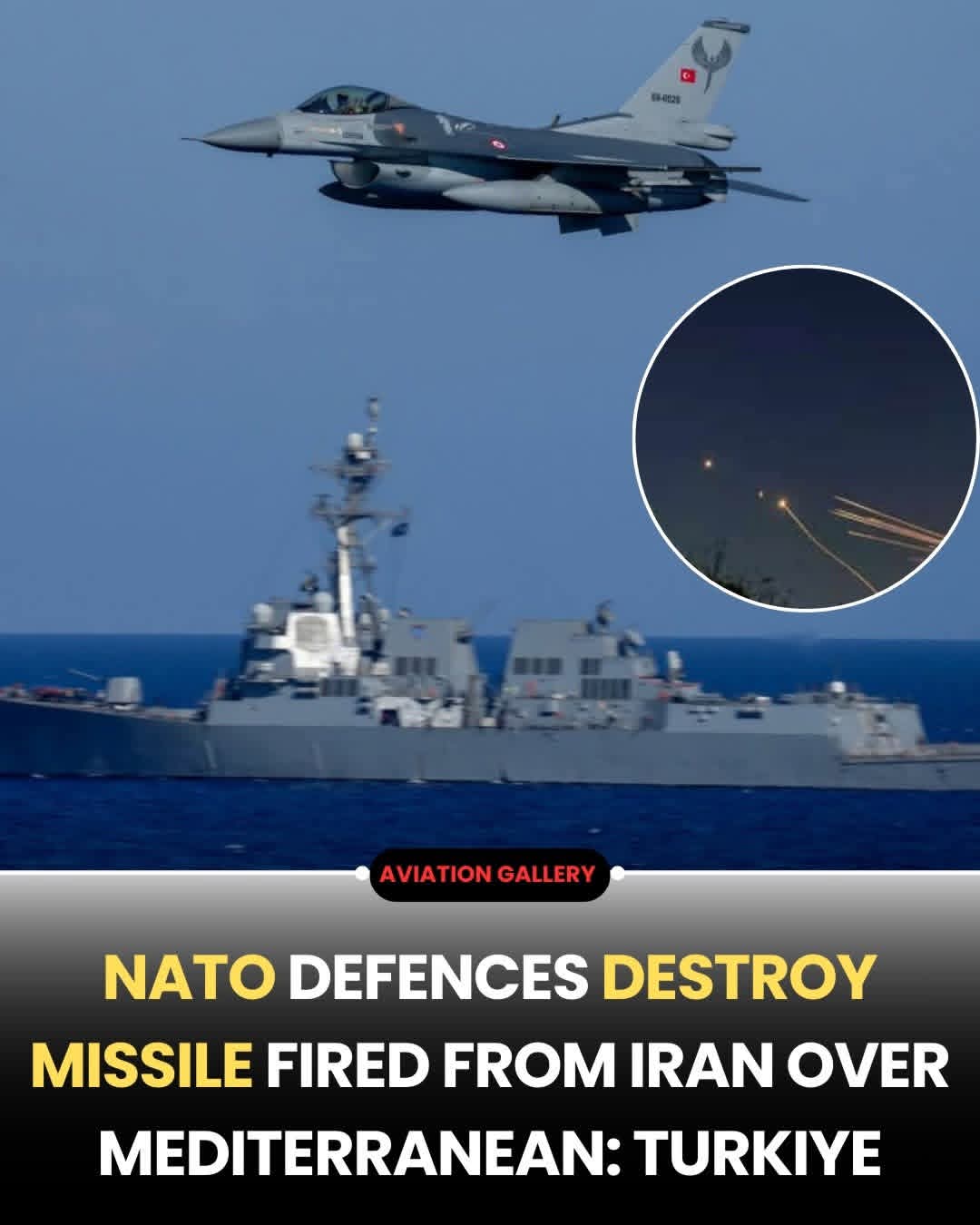
Tensions Cross a Dangerous Line: NATO Intercepts Iranian Missile Bound for Türkiye
The fragile calm in the eastern Mediterranean has been shattered.
According to reports from Al Jazeera, air defense systems linked to NATO intercepted and destroyed a missile launched from Iran as it crossed the Mediterranean Sea, reportedly heading toward Türkiye.
There were no casualties. No confirmed structural damage.
But strategically, everything just changed.
A First in This Escalation
This incident marks the first direct threat to the airspace of a NATO member in the current wave of tensions.
That distinction matters.
For years, confrontations in the region have simmered through proxy battles, drone strikes, cyber operations, and carefully calibrated military maneuvers. But a missile traveling toward alliance territory raises the stakes dramatically.
Ankara has stated it reserves the right to respond, while several NATO allies — including Belgium — have publicly voiced support for Türkiye.
Meanwhile, officials in the United States are reportedly downplaying the likelihood that NATO’s collective defense clause, Article 5, would be triggered.
For now.
Why Article 5 Is the Elephant in the Room
Article 5 is NATO’s most powerful provision — an attack on one member is considered an attack on all.
Invoking it would dramatically widen the conflict, potentially pulling multiple European and North American nations into direct confrontation.
But here’s the nuance:
The missile was intercepted.
No impact occurred.
Intent remains unconfirmed.
That gray area gives diplomats room to maneuver — and militaries time to prepare.
Warning Shot, Miscalculation… or Strategic Signal?
This is where the real debate begins.
Was this:
A calculated warning shot meant to test NATO’s response time?
A navigational or targeting error?
A deliberate escalation meant to redraw red lines?
Missiles do not “accidentally” cross strategic air corridors without consequences. Even if unintended, the symbolism is powerful.
When alliance airspace is approached, response protocols activate automatically. That reality alone shifts the psychological battlefield.
The Region Was Already on Edge
The Mediterranean has become a corridor of rising tension:
Naval deployments have increased.
Air patrols have intensified.
Regional alliances are hardening.
Now, the precedent has changed. A missile trajectory toward NATO territory introduces a new phase — one where deterrence must be visibly enforced.
And deterrence, by its nature, can escalate quickly.
What Happens Next?
Several scenarios are now in play:
🔹 Controlled De-Escalation
Backchannel diplomacy, quiet warnings, and reinforced defensive postures.
🔹 Limited Retaliatory Signal
Türkiye could respond proportionally to reassert deterrence without igniting a wider war.
🔹 Broader Escalation
If intelligence suggests deliberate targeting, pressure to respond collectively could grow.
The United States appears cautious — signaling restraint publicly while likely reinforcing defensive coordination privately.
The Strategic Reality
Even without casualties, the implications are serious.
Airspace sovereignty is one of the clearest red lines in international security doctrine. Crossing it — or even approaching it with offensive weapons — changes the strategic calculus.
Missiles traveling toward alliance territory are not just military events. They are political messages.
And messages like this echo far beyond the Mediterranean.
The Bigger Question
Was this an isolated flashpoint — or the start of a new phase?
The region is already tense. The margin for miscalculation is shrinking.
When missiles begin moving toward alliance airspace, diplomacy must move faster than weapons systems.
Because the next interception might not end as cleanly.

Tensions just crossed another line. According to Al Jazeera, air defenses linked to NATO intercepted and destroyed a missile launched from Iran as it traveled over the Mediterranean Sea toward Türkiye. No reported casualties. No confirmed damage. But the message is loud. This marks the first time in the current escalation that a NATO member’s airspace was directly threatened. Ankara says it reserves the right to respond, while allies including Belgium have voiced support. Officials in the United States are reportedly downplaying the likelihood of Article 5 being triggered. Here’s the real question: Was this a warning shot, a miscalculation, or something bigger? The region is already on edge. When missiles start flying toward alliance territory, the stakes change fast. What do you think happens next?

The Secret Behind the Hairpin: King Charles’s Gift to Charlotte ❤️ Amidst a solemn and dignified ceremony, a 10-year-old girl reminded the world that they are family first, and the monarchy is secondary. Princess Charlotte’s natural, instinctive bow was so graceful that it completely melted away King Charles’s stern expression. Seeing the future of the monarchy in his granddaughter’s eyes, the king was completely overcome with emotion. Witness this unscripted bonding moment, which is moving millions to tears today. ❤️✨ 👉See Now

The UK is sending its HMS Dragon warship to the eastern Mediterranean after attacks on a British base in Cyprus – but it is now expected to set off next week. Find out why…..👇

🔥 BREAKING: Iran Warns “Americans Will No Longer Be Safe Anywhere” World on Edge 👇 Do you think this is a real threat or political posturing? Share your thoughts in the comments. Iran’s Islamic Revolutionary Guard Corps (IRGC) issued a stark warning on March 2, 2026, declaring that the United States “will no longer be safe anywhere in the world, not even in their own homes.” Read more by clicking on the link 👇👇👇

BREAKING: The U.S. embassy in Riyadh, Saudi Arabia, has been struck by two Iranian drones, according to two U.S. officials. The embassy was relatively empty given the overnight hours and no one is believed to have been injured, the U.S. officials said. Read more

U.S. Central Command (CENTCOM) said in a Monday statement that three U.S. Air Force F-15E Strike Eagle fighter jets were “mistakenly shot down by Kuwaiti air defenses” while defending against attacks by Iranian aircraft, missiles and drones. “All six aircrew ejected safely, have been safely recovered and are in stable condition,” the CENTCOM statement said. Read more:

“Unrecognizable?” Critics Slam Taylor Swift — Until Travis Kelce Drops a Six-Word Bombshell 👇 The secret defense that silenced the haters revealed inside

🚨🔥 BREAKING: U.S. and Israel Strike Iran — Tehran Vows Retaliation as Middle East War Fears Explode. What Happens Next Could Change Everything 👇

🚨🔥 Tensions Explode: Iranian Officials Claim U.S. Strikes Could Continue Across Several Major Cities — What Happens Next Could Change Everything. Details Below 👇

🔥 BREAKING: OBAMA REFERENCES TRUMP’S MARRIAGE RECORD ON LIVE TV — 39 SECONDS LATER, THE ROOM GOES TENSE ⚡ It was instant prime-time drama when Barack Obama, in a sharply delivered televised moment, referenced publicly documented details about Donald Trump’s marriage history. The setup was calm, measured, and deliberate—Obama framing the comment within a broader point about public records and political narratives. Then came the reveal-style line. For nearly 39 seconds, the atmosphere shifted. The studio grew noticeably quiet as the weight of the remark settled in. Cameras caught reactions across the room—raised eyebrows, tight smiles, and stunned silence—before the audience finally broke into scattered applause. Observers say the power of the moment wasn’t volume, but contrast: Trump’s confident posture versus Obama’s composed, carefully timed delivery. Within minutes, clips began circulating online, sparking debate across social platforms about tone, boundaries, and political theater. Supporters and critics quickly weighed in, turning the exchange into one of the most talked-about segments of the evening. One thing remained consistent: no private information was revealed and no new allegations were introduced. The segment relied entirely on publicly known material, satire, and live audience reaction. 👇 The full exchange is now trending read more that shifted the energy in under a minute.

“WHEN A 79-YEAR-OLD PRESIDENT SAT SILENT… AND LET HIS BLOODLINE HAND HIM HIS OWN STORY.” Last night didn’t feel like a rally. It felt like a family room with 20,000 people holding their breath. Barron Trump walked out first. Calm. Steady. Then Melania followed graceful, composed. Read full: The arena lights dimmed, and the giant screens slowly filled with moments from decades past early business deals, campaign stops, quiet family holidays, unseen photographs that never made headlines. Donald Trump didn’t speak. He sat there. 79 years of skylines, campaigns, courtrooms, motorcades, and headline-making nights and this time, he just watched. A wife who knows the private chapters. A son who grew up inside the legend. No fireworks. No long speech. Just a family placing a lifetime in front of him one memory at a time. There was a pause near the end. The final image lingered a little longer than the rest. He looked down. Smiled once. That quiet kind of smile that says everything. Some stories become history. Others become inheritance. And for a few minutes… American politics felt smaller. Softer. Personal. Full story in comments 👇
