
CELEBRITY
Trump POWER ENDS as Federal Court REVOKES Immunity. A federal appeals court delivered a historic blow to Donald Trump’s claim of absolute presidential immunity. In a unanimous ruling, the D.C. Circuit Court of Appeals rejected all of Trump’s arguments that he cannot be criminally prosecuted for actions taken while president. The judges made it clear that once Trump left office, he became “Citizen Trump”, subject to the same criminal laws as any other person. The court warned that accepting Trump’s theory would give a president unbounded power to commit crimes, including overturning election results, without accountability—something the judges said would amount to tyranny. They emphasized that no one, not even a president, is above the law. While the Supreme Court later introduced limited immunity for official presidential acts, it did not restore Trump’s demand for total immunity. The Court confirmed there is no immunity for unofficial acts, personal schemes, or efforts to stay in power outside lawful duties. As a result, major parts of Trump’s election-interference case remain prosecutable. His dream of permanent, total immunity is over. For unofficial conduct, Trump is simply a citizen facing criminal charges—just like anyone else.

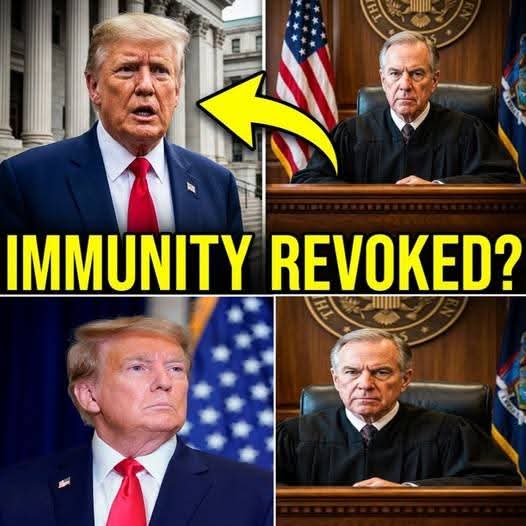
Historic Court Clash Over Trump’s Claim of Presidential Immunity
A federal appeals court dealt a significant legal blow to former President Donald Trump’s bid for absolute presidential immunity this year, unanimously rejecting his argument that he cannot be criminally prosecuted for actions taken while in office.
At issue was Trump’s claim that, because he was president when certain actions occurred, he was categorically shielded from any federal criminal prosecution. The U.S. Court of Appeals for the D.C. Circuit rejected that theory outright, ruling that once Trump left office he became “Citizen Trump,” fully subject to the criminal laws that govern everyone else.
The judges warned that granting absolute immunity would mean a president could commit crimes including attempts to overturn an election without ever being held accountable, a result they said would veer toward tyranny and undermine the rule of law.
The Supreme Court’s Response: Limited, Not Total, Immunity
After the appeals court ruling, the U.S. Supreme Court intervened and reworked the legal landscape on presidential immunity: rather than endorsing Trump’s sweeping claim, the Court narrowly redefined immunity’s scope.
In a 6–3 decision, the Supreme Court held that:
A former president cannot be prosecuted for acts that fall within his core constitutional authority, granting absolute immunity for those specific functions.
For other “official acts,” the president is entitled to presumptive immunity, meaning prosecutors must show those acts lie outside even the broad perimeter of official duties.
Crucially, there is no immunity for unofficial acts conduct that is personal, criminal, or not part of lawful presidential functions.
This means that while immunity may protect some decisions or actions taken within the legitimate office of the presidency, it does not shield actions that fall outside that legal boundary.
The Associated Press
The Supreme Court declined to adopt Trump’s demand for total blanket immunity from criminal prosecution for all presidential acts.
The Associated Press
Why It Matters: Accountability and Presidential Power
Legal experts have underscored the importance of this balance. Without limits on immunity, critics warned, a president could exploit his office with impunity potentially committing serious crimes without ever facing consequences.
At the same time, the Supreme Court’s decision recognizes that presidents must be able to perform official duties without constant fear of litigation a point the majority stressed in defending a level of immunity for lawful executive action
As the court itself noted, the president is not above the law, but lawful immunity for legitimate official acts protects the separation of powers that is central to the U.S. constitutional system.
What This Means for Ongoing Cases
Because of the Supreme Court’s ruling, some aspects of Trump’s criminal cases must be reconsidered under the new framework:
Prosecutors can still pursue charges tied to “unofficial” conduct actions not part of formal presidential duties.
Charges based solely on official acts might be limited or require additional legal analysis to determine their immunity status.
This makes it possible though legally complex for parts of Trump’s election-related prosecution and other federal charges to proceed.
Conclusion: No Blanket Shield, But Not Total Vulnerability
The narrative that Trump’s “power ends” entirely with this ruling is not fully accurate the Supreme Court did grant significant immunity for official acts. However, it also rejected the notion of unlimited immunity, ensuring that a former president can be held accountable for criminal conduct outside the lawful scope of presidential authority.
In other words:
Total immunity? Denied.
Immunity for core responsibilities? Affirmed in part.
Accountability for unauthorized or personal criminal conduct? Intact.
This nuanced legal outcome reflects deep constitutional questions about executive power, accountability, and the rule of law issues that will continue to shape American jurisprudence and politics.
The Associated Press
If you’d like, I can also provide a timeline of this legal saga or explain how the immunity standards might apply to specific charges in Trump’s federal cases.

🚨 “This Won’t Be Another Iraq War” — U.S. Issues Strong Warning to Iran Tensions are rising rapidly in the Middle East after a powerful statement from Mike Waltz. Speaking on Fox News, Waltz said the United States has “all kinds of options” on the table when it comes to confronting Iran’s nuclear ambitions — but made one thing clear: “This isn’t going to be another 2003 Iraq.” According to Waltz, stopping Iran from developing nuclear weapons has been a key promise made by former President Donald Trump throughout his campaigns, and a commitment the administration says it intends to keep. With tensions escalating and the world watching closely, many are asking the same question: What happens next? 👇 Do you think the U.S. should take stronger action against Iran?

Jill Biden is breaking her silence about former President Joe Biden’s decision to abruptly end his 2024 presidential reelection bid. Her new book, “View from the East Wing: A Memoir,” is scheduled to be published on June 2. A political spouse for nearly 50 years, Dr. Biden said she has never publicly discussed her feelings about the three-week stretch when her husband ended his political career, instead saving her thoughts for the pages of her soon-to-be-released memoir. Read more:

THE MONARCHY IS SHAKING! 😱 William and Catherine have just committed the ultimate royal ‘crime’—and the world is screaming for more! Forget the crown; they stepped out looking like star-crossed lovers in a total, obsessed trance! 🥺 Clinging to each other with a raw, electric intensity that defies every palace law… 20 years later and their passion is officially out of control! 🔥 But the real shocker? When the heavy doors closed, the room erupted in frantic whispers and camera madness! 👀 What forbidden act were they secretly doing away from the cameras? View the heart-stopping, unscripted footage before it’s banned: 👇👀 👉 SEE THE ROMANTIC EXPLOSION HERE:

MONARCH’S MESSAGE: King Charles is set to speak Monday about the “increasing pressures of conflict” around the world after President Trump voiced his frustration with Prime Minister Keir Starmer over the UK’s refusal to fully commit to the U.S.-Israeli military operation against Iran. Details below 👇👇👇

As the Iranians get closer to naming their next supreme leader, President Trump said Sunday the new leader “is not going to last long” if the Iranians don’t get his approval first. “He’s going to have to get approval from us,” the president told ABC News. “If he doesn’t get approval from us he’s not going to last long. We want to make sure that we don’t have to go back every 10 years, when you don’t have a president like me that’s not going to do it.” He added, “I don’t want people to have to go back in five years and have to do the same thing again or worse let them have a nuclear weapon.” Read more

🚨 “NO ONE’S TAKING MY TITLE!” Meghan Markle Reportedly Lawyers Up for an Unprecedented Showdown With Prince William Stripped of royal duties and increasingly distanced from the Palace but the title? Meghan reportedly insists that’s untouchable. As Prince William is said to be pushing for major changes within the monarchy, insiders claim Meghan is prepared to fight back legally to protect the one royal status she still holds. What once looked like a quiet royal rift is now being described as something far bigger. Full Details Below👇

REPORT: China President Xi Jinping Send Condolences to Iran, Pledge to Deploy 5,000 Troops to Iran Alongside 200 Advanced Missiles, Drones, Multiple Air Defense Systems, and Anti‑Ship Weapons, Escalating Tensions After U.S. and Israel Strike Led by Donald Trump and Benjamin Netanyahu

It Started With a Routine Traffic Stop… Hours Later, 128 Judges Were Under Arrest What police discovered during that stop allegedly uncovered a seven-year corruption network tied to powerful cartel operations inside the courts. 👉 See how one simple stop exposed everything full story below.

Tensions just crossed another line. According to Al Jazeera, air defenses linked to NATO intercepted and destroyed a missile launched from Iran as it traveled over the Mediterranean Sea toward Türkiye. No reported casualties. No confirmed damage. But the message is loud. This marks the first time in the current escalation that a NATO member’s airspace was directly threatened. Ankara says it reserves the right to respond, while allies including Belgium have voiced support. Officials in the United States are reportedly downplaying the likelihood of Article 5 being triggered. Here’s the real question: Was this a warning shot, a miscalculation, or something bigger? The region is already on edge. When missiles start flying toward alliance territory, the stakes change fast. What do you think happens next?

The Secret Behind the Hairpin: King Charles’s Gift to Charlotte ❤️ Amidst a solemn and dignified ceremony, a 10-year-old girl reminded the world that they are family first, and the monarchy is secondary. Princess Charlotte’s natural, instinctive bow was so graceful that it completely melted away King Charles’s stern expression. Seeing the future of the monarchy in his granddaughter’s eyes, the king was completely overcome with emotion. Witness this unscripted bonding moment, which is moving millions to tears today. ❤️✨ 👉See Now

The UK is sending its HMS Dragon warship to the eastern Mediterranean after attacks on a British base in Cyprus – but it is now expected to set off next week. Find out why…..👇
