
CELEBRITY
A massive pol!tical firestorm has erupted following a public confr0ntation between Senator Mark Kelly and Dona.l.d Tru.m.p. Central to the clash was a devastating question regarding the true meaning of patri0tism, backed by the weight of Kelly’s four generations of family military service. As the fa||out intens!fies, the Tru.m.p campaign is strugg|ing to respond, sparking urgent debates across the capital about the integr!ty of national leadership and the sanct!ty of the uniform. Fu|| st0ry via 🔗 in commen.t.s 👇

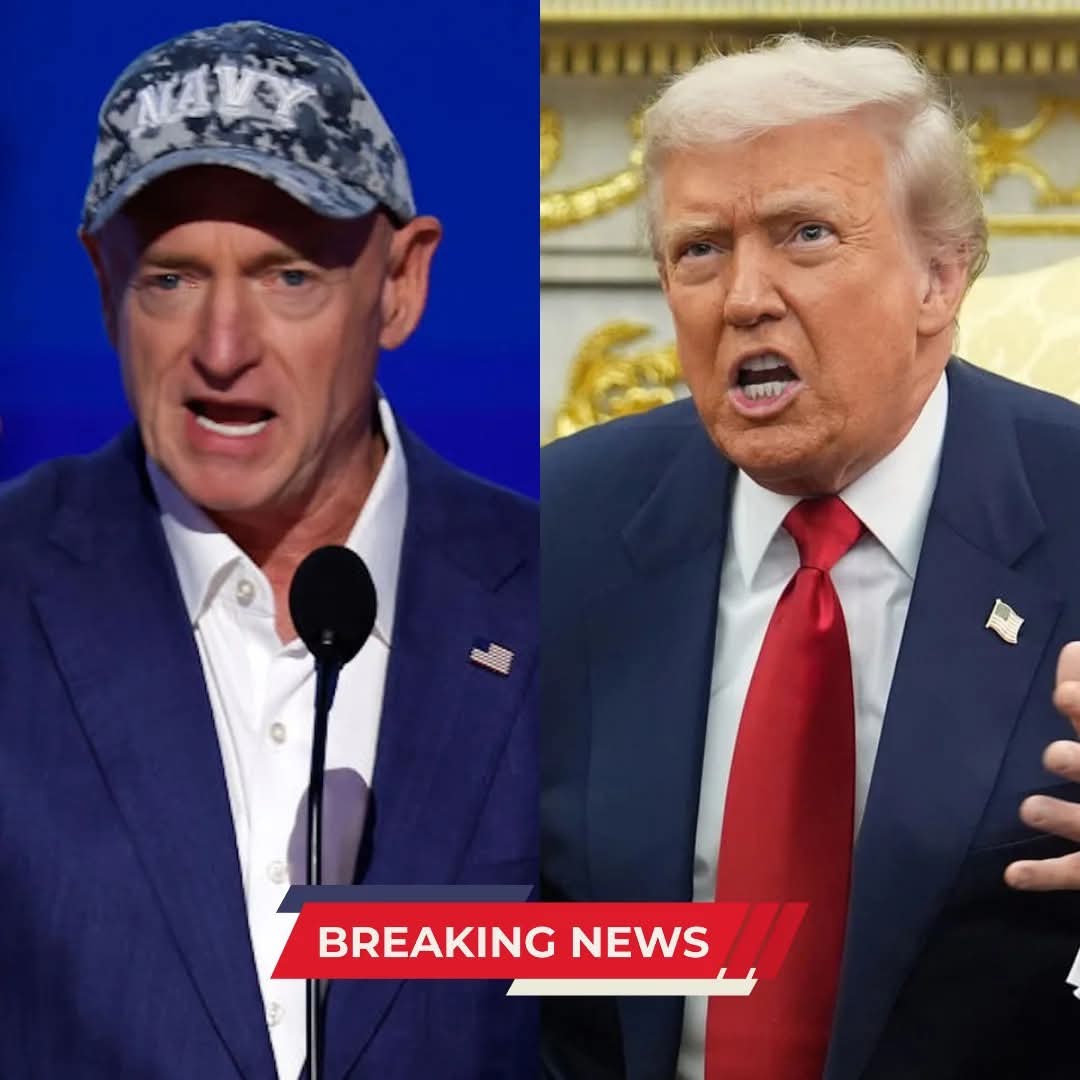
A Question That Shook Washington: Mark Kelly, Donald Trump, and the Battle Over Patriotism
A political firestorm is raging in Washington after a highly charged public confrontation between Senator Mark Kelly and former President Donald Trump one that has ignited fierce debate over patriotism, military service, and the moral authority of national leadership.
At the center of the clash was a single, devastating question posed by Kelly, a former Navy combat pilot and astronaut whose family history includes four generations of military service. According to accounts circulating among political insiders and media commentators, Kelly challenged Trump’s repeated claims of being the ultimate patriot by asking what patriotism truly means when measured against personal sacrifice, service, and respect for those who wear the uniform.
The question landed with unusual force.
Kelly did not raise his voice. He did not posture. Instead, he framed his challenge through the lens of lived experience—speaking not only of his own service, but of a family legacy shaped by war, duty, and national commitment. For many observers, that contrast sharpened an already sensitive national conversation: Is patriotism defined by rhetoric and symbolism, or by action and sacrifice?
The fallout was immediate. Capitol Hill buzzed as lawmakers, veterans’ groups, and political strategists weighed in. Supporters of Kelly praised the senator for articulating what they see as a long-simmering frustration among service members who feel their sacrifices are often invoked but not always honored. Critics of Trump argued that the exchange exposed a vulnerability in his campaign narrative—one that relies heavily on patriotic language but now faces renewed scrutiny over how that language aligns with conduct.
Inside Trump’s political operation, the response appeared uncertain. While allies attempted to reframe the moment as a political attack, others struggled to blunt the emotional resonance of Kelly’s argument. The campaign’s messaging, according to sources close to the situation, has been focused on damage control as the moment continues to circulate widely across social and digital media.
Beyond partisan lines, the confrontation has sparked a deeper debate about the sanctity of the uniform and the responsibilities of those who seek to lead the nation. Veterans and military families have entered the conversation in force, many emphasizing that service is not a prop for political theater, but a lifelong commitment that demands respect.
As the story continues to unfold, one thing is clear: Kelly’s question has tapped into a powerful national nerve. In an election season already defined by sharp divisions, the exchange has elevated patriotism itself into a central issue forcing voters, candidates, and commentators alike to confront what the word truly means, and who has the credibility to define it.
The political aftershocks are far from over. And in Washington, the debate over leadership, integrity, and the meaning of service is only growing louder.

Jill Biden is breaking her silence about former President Joe Biden’s decision to abruptly end his 2024 presidential reelection bid. Her new book, “View from the East Wing: A Memoir,” is scheduled to be published on June 2. A political spouse for nearly 50 years, Dr. Biden said she has never publicly discussed her feelings about the three-week stretch when her husband ended his political career, instead saving her thoughts for the pages of her soon-to-be-released memoir. Read more:

THE MONARCHY IS SHAKING! 😱 William and Catherine have just committed the ultimate royal ‘crime’—and the world is screaming for more! Forget the crown; they stepped out looking like star-crossed lovers in a total, obsessed trance! 🥺 Clinging to each other with a raw, electric intensity that defies every palace law… 20 years later and their passion is officially out of control! 🔥 But the real shocker? When the heavy doors closed, the room erupted in frantic whispers and camera madness! 👀 What forbidden act were they secretly doing away from the cameras? View the heart-stopping, unscripted footage before it’s banned: 👇👀 👉 SEE THE ROMANTIC EXPLOSION HERE:

MONARCH’S MESSAGE: King Charles is set to speak Monday about the “increasing pressures of conflict” around the world after President Trump voiced his frustration with Prime Minister Keir Starmer over the UK’s refusal to fully commit to the U.S.-Israeli military operation against Iran. Details below 👇👇👇

As the Iranians get closer to naming their next supreme leader, President Trump said Sunday the new leader “is not going to last long” if the Iranians don’t get his approval first. “He’s going to have to get approval from us,” the president told ABC News. “If he doesn’t get approval from us he’s not going to last long. We want to make sure that we don’t have to go back every 10 years, when you don’t have a president like me that’s not going to do it.” He added, “I don’t want people to have to go back in five years and have to do the same thing again or worse let them have a nuclear weapon.” Read more

🚨 “NO ONE’S TAKING MY TITLE!” Meghan Markle Reportedly Lawyers Up for an Unprecedented Showdown With Prince William Stripped of royal duties and increasingly distanced from the Palace but the title? Meghan reportedly insists that’s untouchable. As Prince William is said to be pushing for major changes within the monarchy, insiders claim Meghan is prepared to fight back legally to protect the one royal status she still holds. What once looked like a quiet royal rift is now being described as something far bigger. Full Details Below👇

REPORT: China President Xi Jinping Send Condolences to Iran, Pledge to Deploy 5,000 Troops to Iran Alongside 200 Advanced Missiles, Drones, Multiple Air Defense Systems, and Anti‑Ship Weapons, Escalating Tensions After U.S. and Israel Strike Led by Donald Trump and Benjamin Netanyahu

It Started With a Routine Traffic Stop… Hours Later, 128 Judges Were Under Arrest What police discovered during that stop allegedly uncovered a seven-year corruption network tied to powerful cartel operations inside the courts. 👉 See how one simple stop exposed everything full story below.

Tensions just crossed another line. According to Al Jazeera, air defenses linked to NATO intercepted and destroyed a missile launched from Iran as it traveled over the Mediterranean Sea toward Türkiye. No reported casualties. No confirmed damage. But the message is loud. This marks the first time in the current escalation that a NATO member’s airspace was directly threatened. Ankara says it reserves the right to respond, while allies including Belgium have voiced support. Officials in the United States are reportedly downplaying the likelihood of Article 5 being triggered. Here’s the real question: Was this a warning shot, a miscalculation, or something bigger? The region is already on edge. When missiles start flying toward alliance territory, the stakes change fast. What do you think happens next?

The Secret Behind the Hairpin: King Charles’s Gift to Charlotte ❤️ Amidst a solemn and dignified ceremony, a 10-year-old girl reminded the world that they are family first, and the monarchy is secondary. Princess Charlotte’s natural, instinctive bow was so graceful that it completely melted away King Charles’s stern expression. Seeing the future of the monarchy in his granddaughter’s eyes, the king was completely overcome with emotion. Witness this unscripted bonding moment, which is moving millions to tears today. ❤️✨ 👉See Now

The UK is sending its HMS Dragon warship to the eastern Mediterranean after attacks on a British base in Cyprus – but it is now expected to set off next week. Find out why…..👇

🔥 BREAKING: Iran Warns “Americans Will No Longer Be Safe Anywhere” World on Edge 👇 Do you think this is a real threat or political posturing? Share your thoughts in the comments. Iran’s Islamic Revolutionary Guard Corps (IRGC) issued a stark warning on March 2, 2026, declaring that the United States “will no longer be safe anywhere in the world, not even in their own homes.” Read more by clicking on the link 👇👇👇
