
CELEBRITY
Trump Warns Of Possible Further U.S. Strikes In Nigeria Over ‘Attacks On Christians’ Full story in comments section 👇🏽

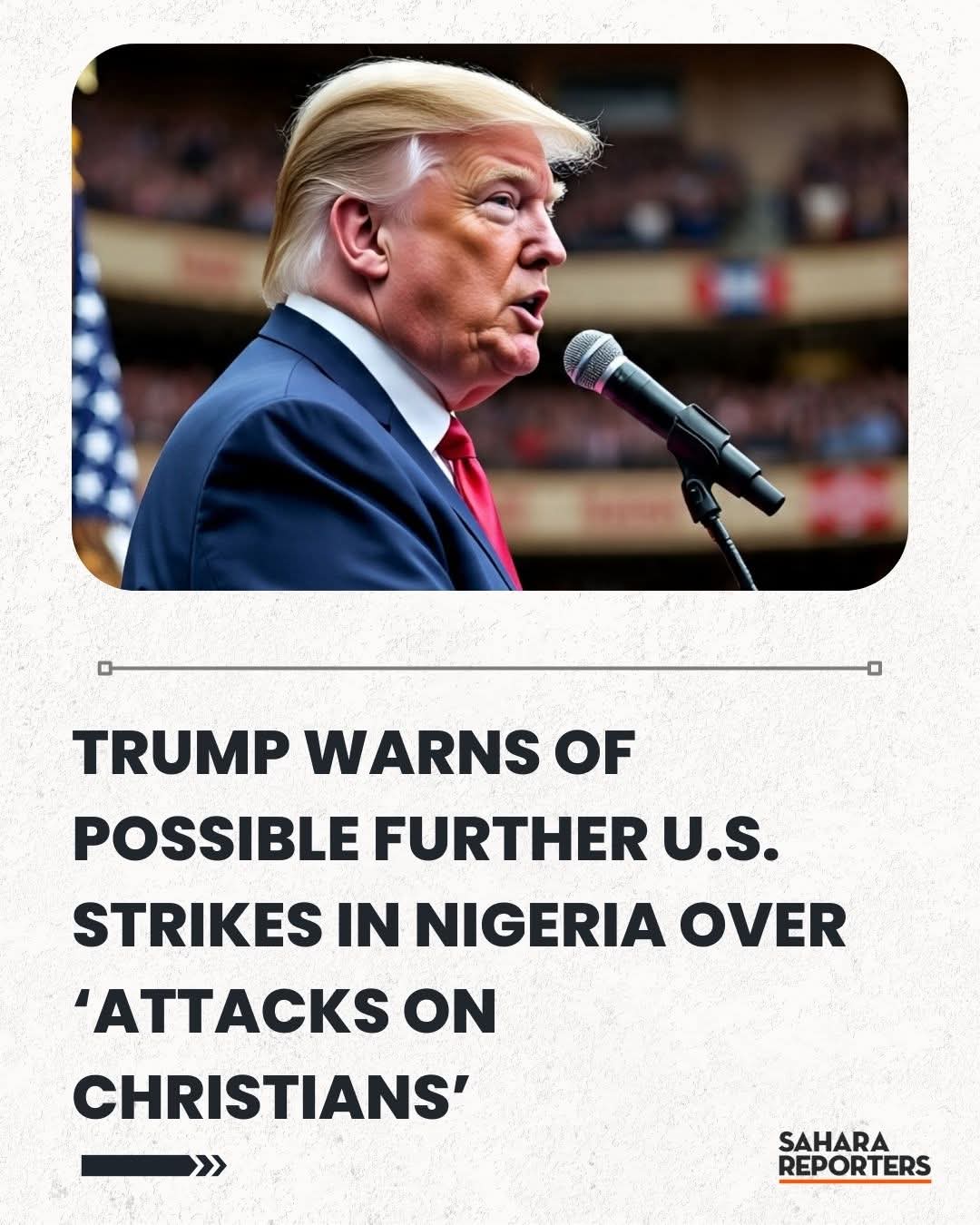
Trump Signals Potential New U.S. Strikes in Nigeria Over Violence Against Christians
Former U.S. President Donald Trump has warned that the United States could carry out additional military strikes in Nigeria if what he describes as attacks on Christians persist. The comments appeared in a January 2026 interview with The New York Times, where Trump tied further action to ongoing violence against Christian communities in parts of Nigeria.
Trump’s remarks revisit a sensitive and complex issue: the U.S. military’s recent involvement in Nigeria, and how that involvement is framed amid Nigeria’s broader security crisis.
Background: Christmas Day Airstrikes
On Christmas Day 2025, U.S. forces carried out airstrikes in northwest Nigeria targeting Islamist militants, primarily groups linked to the Islamic State. The U.S. and Nigerian governments described the operation as a joint effort against terrorism, not a religiously motivated attack. Nigerian officials said the strike was aimed at “terrorists” and rejected claims it was directed at Christians.
Trump positioned the strike as retaliation against militants “killing Christians,” framing the action in terms of protecting religious groups. He suggested it was possible the operation could be the first of many, depending on the evolving situations.
Trump’s Rationale and Broader Narrative
In his interview, Trump said he hoped the Christmas Day strike would be a “one-time” action, but repeated his belief that if Christians continued to be killed, additional strikes could follow. He acknowledged that Muslims were also victims of violence in Nigeria but maintained that Christians were the primary targets.
These comments align with Trump’s previous statements in late 2025, when he described Christianity as facing an “existential threat” in Nigeria and hinted at possible U.S. military involvement if the Nigerian government did not stem violence against Christian communities.
Nigeria’s Position and Security Context
The Nigerian government has consistently denied that Christians face systematic persecution and stressed that armed groups in the country target civilians irrespective of religion. Officials have described the violence as part of a broader terrorist and criminal threat, not a religiously directed campaign.
Nigeria faces numerous security challenges, including insurgencies by Boko Haram and Islamic State-linked factions, armed banditry, kidnappings, and communal conflicts. These threats have affected both Muslim and Christian communities across multiple regions. Independent analysts have noted that casualties from Islamist groups and other armed actors include significant numbers of Muslim victims, complicating narratives that focus solely on religious persecution.
International and Domestic Reactions
U.S. media like The Washington Post have editorially supported continued engagement in Nigeria to counter violent extremist groups, while acknowledging the complexity of the security environment.
Within Nigeria, reactions are mixed. Some communities and political voices have welcomed cooperation against violent groups. Others have expressed concern that foreign military involvement, framed in religious terms, could inflame tensions in an already fragile situation.
What Comes Next?
Trump’s warning underscores several ongoing tensions:
Security vs. Narrative: The challenge of addressing armed groups that target civilians across religious lines, without oversimplifying causes or victims.
Sovereignty and cooperation: Nigeria has framed recent military collaboration with the U.S. as part of coordinated counterterrorism, not unilateral foreign intervention.
Diplomatic balance: The U.S. faces pressure from domestic constituencies emphasizing protection of Christians, while Nigerian leadership stresses internal responsibility and national stability.
As of early January 2026, the possibility of further U.S. strikes remains contingent on how the violence evolves and how diplomatic and military cooperation between Abuja and Washington progresses.
If you’d like, I can also include analysis of how Nigerian civil society and religious groups are responding.

Jill Biden is breaking her silence about former President Joe Biden’s decision to abruptly end his 2024 presidential reelection bid. Her new book, “View from the East Wing: A Memoir,” is scheduled to be published on June 2. A political spouse for nearly 50 years, Dr. Biden said she has never publicly discussed her feelings about the three-week stretch when her husband ended his political career, instead saving her thoughts for the pages of her soon-to-be-released memoir. Read more:

THE MONARCHY IS SHAKING! 😱 William and Catherine have just committed the ultimate royal ‘crime’—and the world is screaming for more! Forget the crown; they stepped out looking like star-crossed lovers in a total, obsessed trance! 🥺 Clinging to each other with a raw, electric intensity that defies every palace law… 20 years later and their passion is officially out of control! 🔥 But the real shocker? When the heavy doors closed, the room erupted in frantic whispers and camera madness! 👀 What forbidden act were they secretly doing away from the cameras? View the heart-stopping, unscripted footage before it’s banned: 👇👀 👉 SEE THE ROMANTIC EXPLOSION HERE:

MONARCH’S MESSAGE: King Charles is set to speak Monday about the “increasing pressures of conflict” around the world after President Trump voiced his frustration with Prime Minister Keir Starmer over the UK’s refusal to fully commit to the U.S.-Israeli military operation against Iran. Details below 👇👇👇

As the Iranians get closer to naming their next supreme leader, President Trump said Sunday the new leader “is not going to last long” if the Iranians don’t get his approval first. “He’s going to have to get approval from us,” the president told ABC News. “If he doesn’t get approval from us he’s not going to last long. We want to make sure that we don’t have to go back every 10 years, when you don’t have a president like me that’s not going to do it.” He added, “I don’t want people to have to go back in five years and have to do the same thing again or worse let them have a nuclear weapon.” Read more

🚨 “NO ONE’S TAKING MY TITLE!” Meghan Markle Reportedly Lawyers Up for an Unprecedented Showdown With Prince William Stripped of royal duties and increasingly distanced from the Palace but the title? Meghan reportedly insists that’s untouchable. As Prince William is said to be pushing for major changes within the monarchy, insiders claim Meghan is prepared to fight back legally to protect the one royal status she still holds. What once looked like a quiet royal rift is now being described as something far bigger. Full Details Below👇

REPORT: China President Xi Jinping Send Condolences to Iran, Pledge to Deploy 5,000 Troops to Iran Alongside 200 Advanced Missiles, Drones, Multiple Air Defense Systems, and Anti‑Ship Weapons, Escalating Tensions After U.S. and Israel Strike Led by Donald Trump and Benjamin Netanyahu

It Started With a Routine Traffic Stop… Hours Later, 128 Judges Were Under Arrest What police discovered during that stop allegedly uncovered a seven-year corruption network tied to powerful cartel operations inside the courts. 👉 See how one simple stop exposed everything full story below.

Tensions just crossed another line. According to Al Jazeera, air defenses linked to NATO intercepted and destroyed a missile launched from Iran as it traveled over the Mediterranean Sea toward Türkiye. No reported casualties. No confirmed damage. But the message is loud. This marks the first time in the current escalation that a NATO member’s airspace was directly threatened. Ankara says it reserves the right to respond, while allies including Belgium have voiced support. Officials in the United States are reportedly downplaying the likelihood of Article 5 being triggered. Here’s the real question: Was this a warning shot, a miscalculation, or something bigger? The region is already on edge. When missiles start flying toward alliance territory, the stakes change fast. What do you think happens next?

The Secret Behind the Hairpin: King Charles’s Gift to Charlotte ❤️ Amidst a solemn and dignified ceremony, a 10-year-old girl reminded the world that they are family first, and the monarchy is secondary. Princess Charlotte’s natural, instinctive bow was so graceful that it completely melted away King Charles’s stern expression. Seeing the future of the monarchy in his granddaughter’s eyes, the king was completely overcome with emotion. Witness this unscripted bonding moment, which is moving millions to tears today. ❤️✨ 👉See Now

The UK is sending its HMS Dragon warship to the eastern Mediterranean after attacks on a British base in Cyprus – but it is now expected to set off next week. Find out why…..👇

🔥 BREAKING: Iran Warns “Americans Will No Longer Be Safe Anywhere” World on Edge 👇 Do you think this is a real threat or political posturing? Share your thoughts in the comments. Iran’s Islamic Revolutionary Guard Corps (IRGC) issued a stark warning on March 2, 2026, declaring that the United States “will no longer be safe anywhere in the world, not even in their own homes.” Read more by clicking on the link 👇👇👇
